
- Dongguan Zhuohang Ltd (registration 91441900MA4UWT6X39), operating as Zhuohang Precision Machining Factory, founded 2005.
- 6,800 m² across two buildings — production/inspection/offices, plus staff dormitories and canteen.
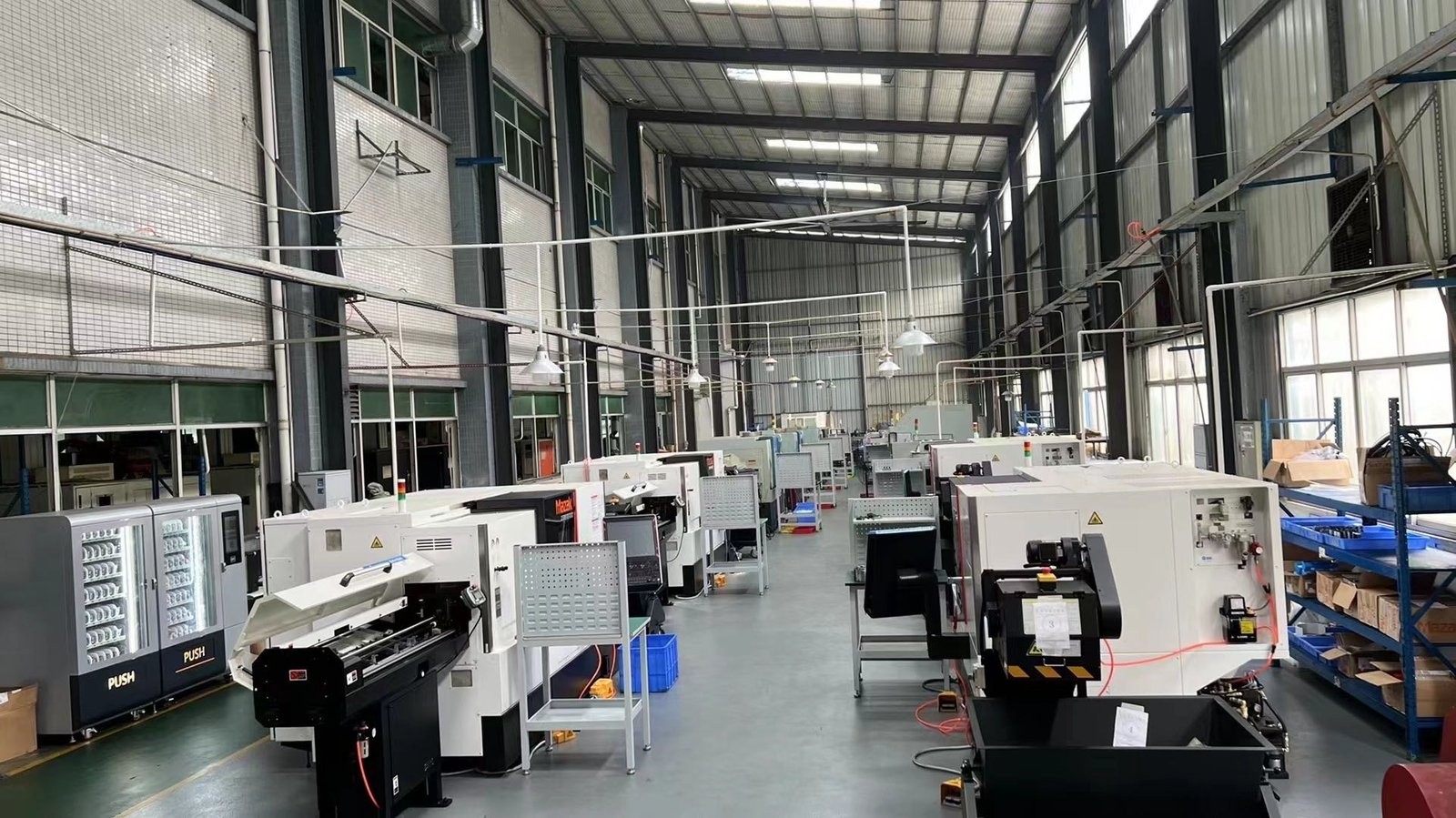
- 100+ machines including 20+ 5-axis centers; 100+ staff, 80%+ skilled technicians.
- ISO 9001 / IATF 16949 / ISO 14001 certified, with 20+ inspection instruments.
Why does the physical factory matter to your lead time?
A quote is only as reliable as the machines behind it. A trading desk can quote 5-axis work it does not own, but the moment demand rises, your part queues in someone else's facility. Owning the floor — the machines, the programmers, the inspection bench — is what makes a date hold. When we quote a 5-axis program, the 20+ 5-axis centers that run it are under this roof.
This is the core of capacity planning: the difference between "we can arrange it" and "it is on our floor." The floor is the part of the lead time you can verify by walking it, which is why we keep it open to audit.
There is a second, quieter way the floor protects a schedule. A desk that resells capacity has to renegotiate its date every time the real owner's load shifts, so its promise is only as stable as someone else's queue. A factory that owns the machines absorbs its own load changes, because it can see them coming and resequence its own floor. Ownership does not make delays impossible; it makes them visible and correctable, which is the difference between a date that holds and one that quietly drifts.
What is the legal and physical identity of the factory?
The legal entity is Dongguan Zhuohang Ltd (China Social Credit / registration number 91441900MA4UWT6X39), which operates under the marketing name Zhuohang Precision Machining Factory. It was founded in 2005 and is headquartered in Hengli Town, Dongguan City, Guangdong Province. The company has traded under earlier names — Dongguan Zhuohang Ltd and Zhuohang Precision Machining Factory — which is normal for a firm that grew from a machining shop into a precision manufacturer.
The registered and factory address is No. 8, Shuibian Songyuan Road, Hengli Town, Dongguan, Guangdong, China 523470.
How is the 6,800 m² campus laid out?
The campus is two buildings on one site. One building holds production, inspection, and offices — the machining floor, the CMM room, and the engineering and sales staff. The other houses staff dormitories and a canteen. The two-building layout matters for one practical reason: production is not squeezed for space, and the people who run the machines live on site, which supports the round-the-clock scheduling that a tight lead time sometimes requires.
How does the on-site campus support round-the-clock scheduling?

A compressed lead time is, in part, a question of how many hours a day the floor can run. When the machinists live on the campus, a shift hand-off does not depend on a commute, and a program that needs a second or third shift can actually get one. This is not a slogan about working harder; it is a layout choice that puts the people next to the machines so that the schedule is not capped at a single eight-hour window.
The second effect is that support functions stay close to the work. Programming, inspection, and engineering sit in the same building as the machining floor, so a question about a tolerance or a setup is answered in minutes rather than by email across time zones. When the schedule is the constraint, the distance between the person who spots a problem and the person who fixes it is part of the lead time, and here that distance is a short walk.
What machines are actually on the floor?
Capacity depth is in the fleet, not in one headline machine. The floor runs 100+ production machines across milling, turning, mill-turn, and grinding, with 20+ 5-axis centers for complex geometry.
| Role | Representative machine families |
|---|---|
| High-speed vertical machining | Brother SPEEDIO S500Z2N / S700Z2N |
| Heavy / mid-size vertical machining | Mazak VCE-430AL / VCE-570CL |
| Turret-style mill-turn | Brother M300X3 RD / M200X3 RD / M200X3 |
| Dual-spindle mill-turn | Mazak QT-COMPACT 200MSY L |
| 5-axis mill-turn | Mazak INTEGREX i-H series |
| Vertical 5-axis machining | Mazak VARIAXIS i series |
| Swiss-type turning | Citizen Cincom A20 / Star SR-32JII / Tsugami B0205 |
What this fleet means for scheduling: a complex 5-axis part does not wait behind a single machine, and a prototype can scale to production on the same floor. That depth is the difference between a quote that holds and one that slips.
How does the fleet divide labor across the three lead-time tiers?
The machine list is not a menu of unrelated items; it is a routing map for the three tiers. Each family has a job in the schedule, and the depth in each family is what lets a part land in the tier its geometry actually deserves.
| Machine family | Count | Role in the schedule |
|---|---|---|
| 3-axis vertical machining | 50+ centers | Absorbs short-tier prismatic work at the lowest cost per part |
| 4-axis machining | 20+ centers | Indexed multi-face parts without re-fixturing |
| 5-axis machining | 20+ centers | Single-setup complex geometry; the mid and long tiers |
| CNC turning | 25+ lathes | Round parts, including mill-turn in one clamping |
| Precision grinding | 7+ grinders | Final tolerance on bearing seats and roundness-critical faces |
The pattern you should read out of this is redundancy in the right places. The 3-axis depth means simple parts never queue behind a complex 5-axis program; the 5-axis depth means a complex part never waits behind a single machine. The tiers hold because each one has its own lane of machines, not because one overloaded machine is doing everything.
Who runs the machines?
Machines do not run themselves. The floor has 100+ employees, and 80% or more are skilled technicians — the programmers, machinists, and inspectors who turn a CAD model into a measured part. A factory that invested in machines but not people can own the equipment and still miss the tolerance; the two have to come together, which is why we report the technician ratio rather than just a headcount.
What engineering and programming staff sits behind the machines?
Between your CAD model and a finished part sits a programming step, and for complex 5-axis geometry that step can be the longest single item in the schedule. The staff who write the tool paths — and who decide how many setups a part really needs — are the people who turn a routing decision into a date. This floor keeps CAD/CAM programmers and process engineers in-house, in the same building as the machines, rather than outsourcing the step that most directly controls the lead time.
That matters for two reasons. First, an in-house programmer can walk to the machine and resolve a tool-path question in person instead of through a remote queue. Second, the programmer who routes your part is the same person accountable for the setup count, so the "fewest steps" decision is made by someone who actually runs the floor, not by a sales desk quoting a capability it does not program. The staff is the part of the capacity a buyer cannot see in a machine list, but it is the part that decides whether the list delivers.
What backs the quality and environmental claims?
Three certificates, each with a number you can verify with the registrar:
| Standard | Certificate number |
|---|---|
| ISO 9001:2015 | 116024/A/0001/UK/En |
| IATF 16949:2016 | 131941/A/0001/SM/En |
| ISO 14001:2015 | 116024/B/0001/UK/En |
The environmental system is backed by action as well as paper: solar panels on the factory roof generate about 20,000 kWh of green power a month. For you auditing sustainability claims, that is a measurable line item, not a slogan.
How are the inspection instruments tied to the tolerance you are quoted?
A tolerance is only worth as much as the instrument that verifies it, and inspection capacity is a hidden part of the schedule. If a floor can machine to ±0.003 mm (milling) / ±0.002 mm (turning) but its CMM queue is the bottleneck, the parts still wait, and if you only ask about machines, you miss the real constraint. This floor runs 20+ inspection instruments alongside the machines, so measurement capacity scales with machining capacity instead of trailing behind it.
The instruments are chosen to match the claims, not just to fill a list. Coordinate measuring machines verify dimensional tolerances and true position; vision systems and profile instruments verify surface finish and geometry; hardness testers and coating gauges verify heat treatment and plating results; and an XRF spectrometer verifies incoming material composition against the mill certificate. Each instrument answers one specific claim, which is why the quoted tolerance and the inspection bench are read together rather than separately.
How does fleet depth protect a schedule when a machine goes down?
Every machine eventually needs maintenance, and a schedule built on a single machine is a schedule built on a single point of failure. The point of fleet depth is not that breakdowns never happen; it is that a breakdown re-routes work instead of stopping it. When one 5-axis center is pulled for service, another center of the same family takes the job, because the floor runs a fleet of the same machine types rather than one of each.
This is a different kind of insurance than a maintenance log. Preventive maintenance keeps a machine running longer, but only redundancy keeps the schedule running when maintenance happens. A buyer reading a capacity claim should ask not just "how many machines" but "how many of the same kind", because two of the same machine can absorb each other's load, while two unrelated machines each carry their own single point of failure.
What should you check before trusting the capacity?
Whether you buy from this factory or another, these checks separate a real floor from a brochure.
- Can they name the registration number? Ours is 91441900MA4UWT6X39 — a trading desk often will not publish one.
- Do they name machine families and counts? A manufacturer lists models; a reseller recycles stock photos.
- Are the certificate numbers verifiable? Real ISO/IATF certificates carry numbers you can check.
- Can you walk the floor? Audits are welcome at No. 8, Shuibian Songyuan Road, Hengli Town, Dongguan.
What this shop actually runs
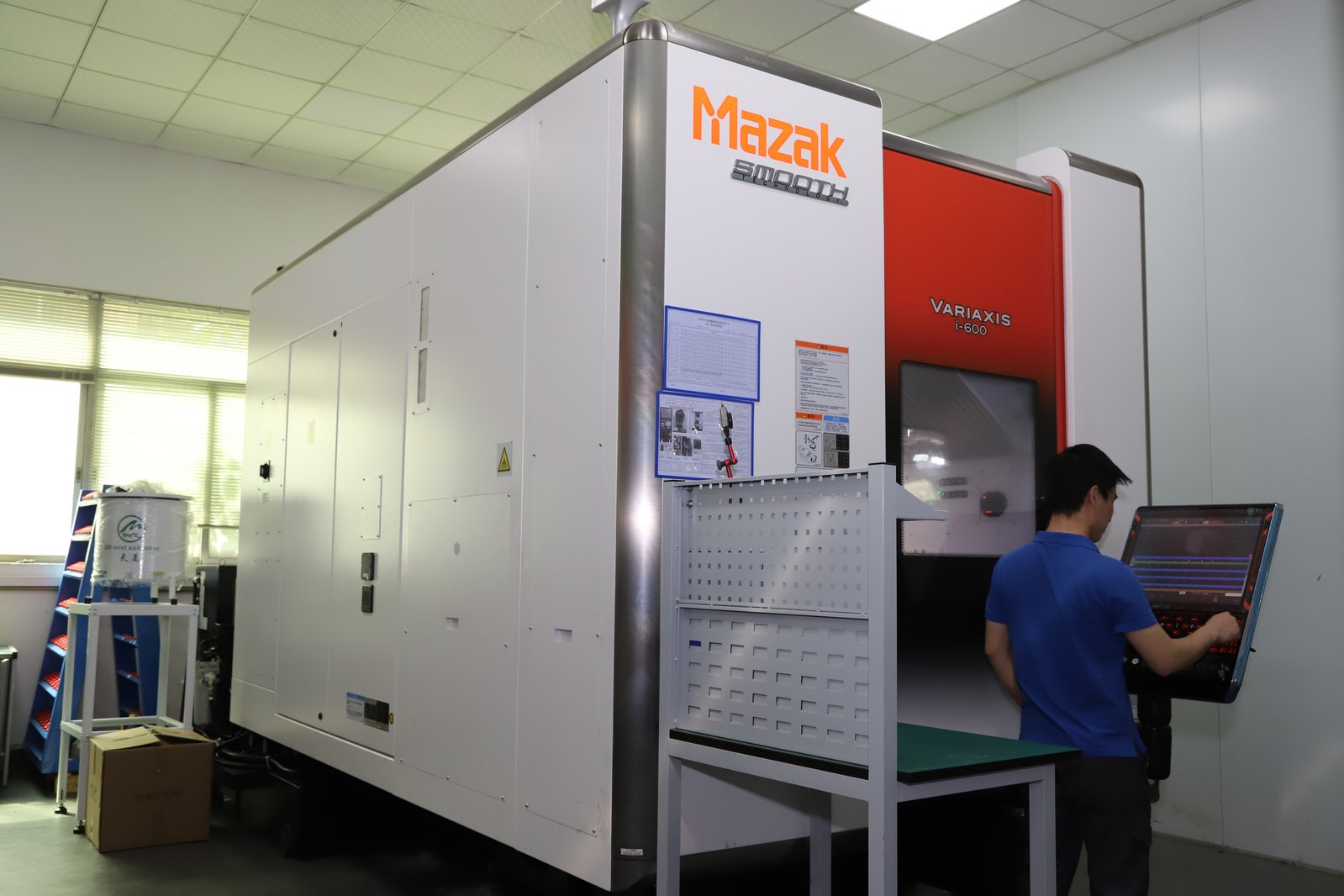
We machine every part in our own 6,800 m² plant in Dongguan, China, on 100+ CNC machines with 100+ staff. The machine list by category:
- 5-axis machining centres (10+) - Mazak VARIAXIS I-600 (510/910/510 mm travel, 12,000 rpm, 22 kW, 71.6 N·m, 30-tool BT40) and Mazak INTEGREX I-250H S (B-axis 0.0001°, 24 kW, 124 N·m, 38-tool HSK-A63). Suited to compound-angle parts, single-setup multi-face prismatic work, and aerospace fittings where datum transfer loss is unacceptable.
- 3-axis / 4-axis machining centres (50+) - Brother SPEEDIO S500Z2N / S700Z2N (10,000 rpm, 14/21-tool ATC, 0.7 s tool-to-tool, Z-axis 2.2 G) and Mazak VCE-430A L / VCE-570C L (10,000 rpm, 118 N·m, 24-tool ATC). Suited to prismatic parts, plates, brackets, housings.
- Swiss-type turning centres (10+) - Citizen Cincom A20-3F7 (Φ20 mm, 10,000 rpm), TSUGAMI B0206-III / B0205-III (Φ20 mm, 0.1 µm), STAR SR-32JII / SR-32J Type N (Φ32 mm, 8,000 rpm). Suited to long, slender rotational parts at ±0.002 mm.
- CNC turning centres (20+) - HEADMAN T70M/1250 (720 mm swing, 117 mm bore, 3,000 rpm, BMT75 12-station turret). Suited to shafts, bushings, flanges up to ±0.002 mm.
- Wire EDM (5+) - Sodick AQ535L (550/350/300 mm travel, ±20° taper, 800 kg workpiece). Suited to hardened tool steel, internal splines, sharp internal corners that milling cannot reach.
- Inspection: Hexagon CMM + 20+ gauges - Hexagon CMM for coordinate measurement, plus vision system, profilometer, hardness tester, coating thickness gauge, XRF for material verification. The 10:1 rule (gauge 10x more accurate than the band) is applied to every feature.
- Machine highlights - VARIAXIS I-600: one-setup multi-face 5-axis + MAZA-CHECK auto-calibration; INTEGREX I-250H S: DONE-IN-ONE mill-turn, B-axis 0.0001° + Ai thermal shield; SPEEDIO S500Z2N / S700Z2N: Z-axis 2.2 G + 0.7 s ATC; Swiss-type: guide-bush switchable + 0.1 µm resolution.
Tolerance: ±0.003 mm CNC milling / ±0.002 mm CNC turning / ±0.002 mm grinding and wire EDM. Capability: Ppk >= 1.67 initial on key characteristics, Cpk >= 1.33 ongoing.
Certificates: ISO 9001:2015 (116024/A/0001/UK/En), IATF 16949:2016 (131941/A/0001/SM/En, with design clause 8.3 excluded, stated openly) and ISO 14001:2015 (116024/B/0001/UK/En), issued to Dongguan Zhuohang Ltd, registration 91441900MA4UWT6X39, founded 2005.
Where we ship: Austria, Belgium, the Czech Republic, Denmark, France, Germany, Greece, Hungary, Ireland, Italy, the Netherlands, Spain, Sweden and the United Kingdom in Europe; Brazil, Canada, Mexico and the United States in the Americas; China, Israel, Japan, Singapore and Sri Lanka in Asia; Australia and New Zealand in Oceania; and South Africa in Africa — plus other countries and regions worldwide, shipped from our base in Dongguan, China.
Contact: Felipe Iglesias, [email protected], +86 13126536955.
Want to verify the capacity in person?
Arrange a factory visit or video audit with [email protected] or +86 13126536955.
Frequently Asked Questions
Are you a real manufacturer or a trading company?
A manufacturer. The legal entity is Dongguan Zhuohang Ltd (registration 91441900MA4UWT6X39), operating a 6,800 m² facility with more than 100 machines and 100+ staff. Factory visits are welcome at the Dongguan address.
How large is the facility?
6,800 m² across two buildings — one for production, inspection, and offices, the other for staff dormitories and a canteen. The campus is at No. 8, Shuibian Songyuan Road, Hengli Town.
How many machines and people are on the floor?
The floor runs 100+ production machines, including 20+ 5-axis centers, alongside 20+ inspection instruments and 100+ employees, of whom 80% or more are skilled technicians and machinists.
What certifications does the factory hold?
The factory holds ISO 9001:2015 (No. 116024/A/0001/UK/En), IATF 16949:2016 (No. 131941/A/0001/SM/En), and ISO 14001:2015 (No. 116024/B/0001/UK/En), all issued by the registrar URS and verifiable by number.
When was the company founded?
The company was founded in 2005 and is headquartered in Hengli Town, Dongguan, Guangdong Province. It operates under the marketing name Zhuohang Precision Machining Factory and the legal name Dongguan Zhuohang Ltd
Can I visit or audit the factory?
Yes. The facility is at No. 8, Shuibian Songyuan Road, Hengli Town, Dongguan, Guangdong, China 523470, and both on-site and video audits are welcome.
How does the on-site campus keep shifts running?
The staff dormitories and canteen sit on the same campus as the production building, so a shift hand-off does not depend on a commute. When a schedule needs a second or third shift, the people who run the machines are already on site.
What happens if a machine needs maintenance mid-order?
In short, The fleet runs several machines of each family, so a machine pulled for service is replaced by another of the same type and the job re-routes instead of stopping. Depth of the same machine kind is what keeps a single breakdown from becoming a slipped date.
How does the machine list matter to my lead time?
It shows which tier your part can land in. Deep 3-axis capacity keeps simple parts off the 5-axis queue, and 20+ 5-axis centers let a complex part run in parallel rather than wait behind a single machine.
Continue reading: 3 Axis CNC Milling · 4 Axis CNC Milling · 3 Axis 5axis CNC Milling
Standards referenced on this page
- ASTM A582/A582M-12 — Standard Specification for Free-Machining Stainless Steel Bars
- ISO 14001 — Environmental management systems — Requirements with guidance for use
- ASTM E8/E8M-21 — Standard Test Methods for Tension Testing of Metallic Materials