
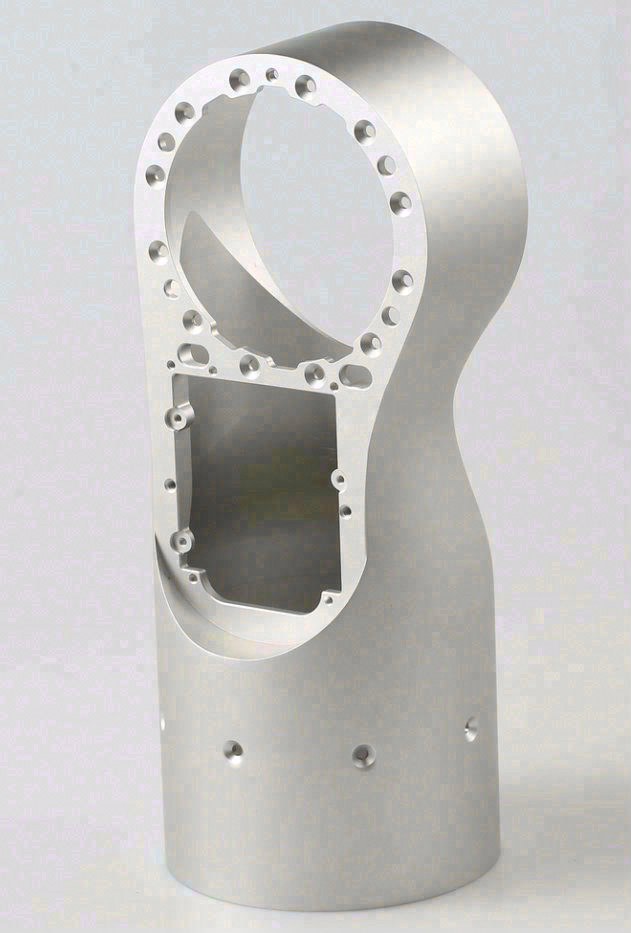
Aluminum or stainless steel? It is the most common material question you face, and on 5-axis CNC parts the stakes are higher than usual, because the part has often earned its way onto a 5-axis machine through complex geometry, thin walls, or multi-face features — exactly the situations where material properties decide whether the part works at all. The short version: aluminum wins on weight, thermal performance, and machined cost; stainless wins on corrosion resistance, stiffness in a small envelope, temperature capability, and surface hardness. Everything else is a trade-off
Why does the aluminum-versus-stainless call matter more on a 5 axis part?
On a simple 3-axis bracket, a material mistake costs a few dollars of stock and a re-run. On a 5-axis part, the same mistake is expensive twice. First, the programming, fixturing, and inspection work that surrounds a complex part is identical for both materials — switch alloys after quoting and you redo the quote, the schedule, and possibly the tooling, not just the material line. Second, the geometry that justifies 5-axis machining — deep pockets, thin walls, sculpted surfaces — is exactly where material differences show up in deflection, vibration, and achievable finish.
There is also a machining-side effect that favors keeping the decision early. Aluminum cuts at high spindle speeds with light chatter risk, so thin-wall aluminum parts can be pushed hard. Stainless is roughly three times stiffer than aluminum but cuts at a fraction of the speed, work-hardens if the tool dwells, and conducts heat poorly, so the heat stays in the tool and the part. The right material for the duty is the right material for the geometry, and both families are entirely machinable on 5-axis equipment when the program respects their behavior.
What do 6061-T6 and 7075-T6 give you in aluminum?
6061-T6 is the workhorse. Its yield strength of about 276 MPa is modest, but it machines cleanly at high speed, holds ±0.003 mm milling tolerances without drama, and takes anodize reliably, which makes it the default for housings, brackets, heat sinks, and prototypes across industries. Density is 2.70 g/cm³, about a third of steel, and thermal conductivity is roughly ten times that of stainless — why electronics and power parts are almost always 6061.
7075-T6 is the upgrade when the design is strength-limited. Its yield strength of about 500 MPa approaches some steels at a third of the weight, which is why it appears in structural and aerospace-adjacent parts where every gram is budgeted. The costs of that strength: roughly two to three times the stock price of 6061, slightly slower machining, and lower corrosion resistance in some conditions, so 7075 parts are usually anodized or painted in service. If the drawing says "aluminum" without a grade, you will be quoted 6061-T6, which is right for most parts and wrong only when the design truly needs the extra strength.
Which stainless grades matter for machined parts, and how do they differ?
Stainless is a family, not a material, and the differences between grades change both the part and the quote. All of them sit near 7.9 g/cm³ — about three times denser than aluminum — with a Young's modulus near 193 GPa, giving roughly three times the stiffness of aluminum for the same geometry. The useful grades for CNC work are:
| Grade | What it is | Machining behavior | Typical 5-axis parts |
|---|---|---|---|
| 303 | Free-machining austenitic; added sulfur breaks chips | Best machinability of the stainless family; bright finish | Fittings, valve stems, sensor housings, fasteners |
| 304 | General-purpose austenitic | Moderate; work-hardens if cuts are light or tools dwell | Structural and food-contact parts, enclosures |
| 316L | Adds molybdenum for chloride and pitting resistance; low carbon | Moderate; tougher on tooling than 304 | Marine, chemical, and pharmaceutical components |
| 17-4PH | Precipitation-hardening martensitic | Machines well annealed; strong and hard after heat treatment | High-strength structural parts, aerospace actuators |
The rule of thumb: 303 when you just need a corrosion-resistant machined part at the lowest machined cost, 304 when the part also gets welded or formed, 316L when chlorides and process chemicals are in the picture, and 17-4PH when you need real strength, not just corrosion resistance.
When is 17-4PH the right stainless over 304 or 316L?
If the part is a housing that keeps water out, 304 or 316L is fine. If the part carries load — a clevis, a link, a bracket in a mechanism that sees vibration or impact — the annealed austenitics cap out around 200–300 MPa yield, and a stainless part that has to be strong becomes a big, heavy part. 17-4PH solves that: in the H900 condition it reaches yield strengths in the region of 1100 MPa, stronger than most carbon steels, while keeping the corrosion resistance of the stainless family.
That strength changes the design conversation. A load-bearing stainless part in 17-4PH can be smaller and lighter than the equivalent 304 design, which is why aerospace and defense actuators, valve components, and precision mechanisms specify it. The trade-offs are real: 17-4PH costs more per kilogram, is machined in the soft annealed condition and then heat-treated, which means the schedule and tolerance strategy must account for a treatment step and a finishing pass. A shop that does the machining, sends the part out for age hardening, and finishes it after will hold the tight geometry, but that sequence is exactly why the material decision has to be made before the quote, not after.
Strength, stiffness, and weight: when does aluminum win?
Run the numbers on a notional wall. A 1 mm aluminum wall and a 0.5 mm stainless wall weigh about the same, but the stainless wall is roughly twice as stiff because the modulus advantage overcomes the thinner section. If the envelope is fixed and you need stiffness, stainless wins. If the constraint is weight — the part rides on a robot arm, a drone, or a vehicle — aluminum wins outright: 7075-T6 delivers a strength-to-weight ratio that most steels cannot match, and 6061 is not far behind on a stiffness-per-weight basis, because aluminum's lower modulus is offset by its low density.
Then add the service conditions that tip it further. Aluminum conducts heat roughly ten times better than stainless, so heat sinks and thermal paths stay in aluminum. Aluminum's higher thermal expansion means a precision assembly that cycles through wide temperature swings needs the differentials designed out — a stainless shaft in an aluminum housing is a classic pairing for exactly that reason. And for thin-wall accuracy during machining, aluminum's low cutting forces let a 5-axis machine hold fine features without deflection, while a comparable stainless thin wall demands slower, shallower cuts to avoid pushing the wall. When weight, thermal performance, and machined cost matter, aluminum is the answer; when stiffness per millimeter and temperature resistance matter, stainless is.
Corrosion and environment: when do you have to move to stainless?
Aluminum protects itself with a native oxide film that is excellent in dry, indoor air, which is why millions of machined housings sit happily in electronics for decades. The film fails where chlorides and moisture concentrate: coastal salt air, road salt, chemical washdowns, and process fluids. In those environments bare aluminum pits, and an anodized coating only postpones it, because the coating is thin and any scratch or cut edge re-exposes the substrate.
That is the line that forces a move to stainless. When the part faces salt water or marine spray, 316L is the conventional answer. When it faces food processing and repeated caustic washes, 304 or 316L with passivation. When it sees industrial chemicals, pick the grade on the actual media. Passivation — a standard step that removes free iron from the surface and restores the chromium oxide layer — is what makes machined stainless live up to its name, and on this site every incoming lot is XRF-verified against its mill certificate so the grade that protects the part is the grade that was cut. If your environment is aggressive, do not design in aluminum hoping a coating will save you; the surface finish and corrosion engineering that works on machined parts is covered in the parts and applications guide.
How do the two families compare on finish, tolerance, and machining behavior?
Both families hold the same production tolerances on 5-axis equipment — ±0.003 mm on milled features, ±0.002 mm where grinding is applied, with Ppk ≥ 1.67 initial tracked on key characteristics — but the path there is different. Aluminum reaches a fine as-machined surface easily and anodize can be dyed or specified in hard (Type III) form for wear. Stainless does not take an anodic coating; its surface treatment is passivation for corrosion or electropolishing for a smooth, clean finish, and it can be ground or lapped when the part needs a sealing surface.
The machining behavior differs most in the details. Aluminum produces stringy chips at high speed and conducts heat away, so tool life is long and cycle times are short. Stainless work-hardens — a dull tool that rubs instead of cuts leaves a hard, galled surface — so the program must keep the tool engaged with consistent chip load. That is a programming discipline, not a capability limit, and it is precisely where a 5-axis setup earns its keep: a rigid single-setup hold keeps the tool engaged and the vibration low, which is what lets stainless hold tight tolerance without the chatter that ruins a finish on re-fixtured parts. If a surface finish or anodize requirement is in your future, state it on the RFQ — finishes belong in the quote and the schedule, as the FAQs on finishes and tolerances explain.
What changes on the quote and the calendar when you switch alloys?
Switching from aluminum to stainless changes three lines on the quote at once. Material cost: stainless stock runs roughly two to four times the cost of 6061-T6 per kilogram, with 316L and 17-4PH above the middle of that band. Machining time: stainless cuts at a fraction of the speed of aluminum, so the same geometry consumes more spindle minutes — commonly two to four times on comparable features. Finishing: anodize on aluminum versus passivation or electropolish on stainless are different vendor steps with different costs.
The calendar moves too. Stainless grades in common sizes are usually stocked, but 17-4PH adds a heat-treatment leg between roughing and finishing, and any certified lot adds the incoming verification step. A design change from aluminum to stainless after quoting is effectively a new project: new material line, new program strategy, new finish, new date. The decision table below is the summary to keep on the wall.
| Decision driver | Choose aluminum | Choose stainless |
|---|---|---|
| Weight is the constraint | 6061-T6 or 7075-T6 | Only if strength demands steel |
| Stiffness in a fixed envelope | Thicken sections | 304 or 316L — modulus wins |
| Strength under load | 7075-T6 | 17-4PH |
| Salt, chemical, or washdown duty | Only with robust coating | 316L plus passivation |
| Heat dissipation | 6061-T6 | Poor conductor; avoid |
| Lowest machined cost at low volume | 6061-T6 | Rarely |
| High-temperature service | Strength drops fast | 304, 316L, 17-4PH |
| Wear and surface hardness | Hard anodize | As-machined or hardened 17-4PH |
For the full cost picture behind the switch — where the machining-time multiplier lands and how the fixed lines spread across quantity — the 5-axis CNC milling cost guide works through the numbers. When the duty is clear and the grade is on the drawing, the quote and the part both behave.
What this shop actually runs
We machine every part in our own 6,800 m² plant in Dongguan, China, on 100+ CNC machines with 100+ staff. The machine list by category:
- 5-axis machining centres (10+) - Mazak VARIAXIS I-600 (510/910/510 mm travel, 12,000 rpm, 22 kW, 71.6 N·m, 30-tool BT40) and Mazak INTEGREX I-250H S (B-axis 0.0001°, 24 kW, 124 N·m, 38-tool HSK-A63). Suited to compound-angle parts, single-setup multi-face prismatic work, and aerospace fittings where datum transfer loss is unacceptable.
- 3-axis / 4-axis machining centres (50+) - Brother SPEEDIO S500Z2N / S700Z2N (10,000 rpm, 14/21-tool ATC, 0.7 s tool-to-tool, Z-axis 2.2 G) and Mazak VCE-430A L / VCE-570C L (10,000 rpm, 118 N·m, 24-tool ATC). Suited to prismatic parts, plates, brackets, housings.
- Swiss-type turning centres (10+) - Citizen Cincom A20-3F7 (Φ20 mm, 10,000 rpm), TSUGAMI B0206-III / B0205-III (Φ20 mm, 0.1 µm), STAR SR-32JII / SR-32J Type N (Φ32 mm, 8,000 rpm). Suited to long, slender rotational parts at ±0.002 mm.
- CNC turning centres (20+) - HEADMAN T70M/1250 (720 mm swing, 117 mm bore, 3,000 rpm, BMT75 12-station turret). Suited to shafts, bushings, flanges up to ±0.002 mm.
- Wire EDM (5+) - Sodick AQ535L (550/350/300 mm travel, ±20° taper, 800 kg workpiece). Suited to hardened tool steel, internal splines, sharp internal corners that milling cannot reach.
- Inspection: Hexagon CMM + 20+ gauges - Hexagon CMM for coordinate measurement, plus vision system, profilometer, hardness tester, coating thickness gauge, XRF for material verification. The 10:1 rule (gauge 10x more accurate than the band) is applied to every feature.
- Machine highlights - VARIAXIS I-600: one-setup multi-face 5-axis + MAZA-CHECK auto-calibration; INTEGREX I-250H S: DONE-IN-ONE mill-turn, B-axis 0.0001° + Ai thermal shield; SPEEDIO S500Z2N / S700Z2N: Z-axis 2.2 G + 0.7 s ATC; Swiss-type: guide-bush switchable + 0.1 µm resolution.
Tolerance: ±0.003 mm CNC milling / ±0.002 mm CNC turning / ±0.002 mm grinding and wire EDM. Capability: Ppk >= 1.67 initial on key characteristics, Cpk >= 1.33 ongoing.
Certificates: ISO 9001:2015 (116024/A/0001/UK/En), IATF 16949:2016 (131941/A/0001/SM/En, with design clause 8.3 excluded, stated openly) and ISO 14001:2015 (116024/B/0001/UK/En), issued to Dongguan Zhuohang Ltd, registration 91441900MA4UWT6X39, founded 2005.
Where we ship: Austria, Belgium, the Czech Republic, Denmark, France, Germany, Greece, Hungary, Ireland, Italy, the Netherlands, Spain, Sweden and the United Kingdom in Europe; Brazil, Canada, Mexico and the United States in the Americas; China, Israel, Japan, Singapore and Sri Lanka in Asia; Australia and New Zealand in Oceania; and South Africa in Africa — plus other countries and regions worldwide, shipped from our base in Dongguan, China.
Contact: Felipe Iglesias, [email protected], +86 13126536955.
Not sure which alloy fits the duty?
Send the STEP or IGES model and the service conditions to [email protected] or call +86 13126536955. You will get a material recommendation with the machined-cost difference shown, not just a quote for the grade you guessed.
Frequently Asked Questions
Is 6061-T6 or 7075-T6 better for a CNC-milled part?
In short, 6061-T6 is the everyday choice: it machines easily, holds tight tolerances, anodizes well, and is the cheapest aluminum to cut, so it suits housings, brackets, and prototypes. Choose 7075-T6 when the design is strength-limited and weight matters, because its yield strength is roughly 80 percent higher than 6061-T6, and accept the higher stock cost and lower corrosion margin in some environments.
Which stainless steel grade is easiest to machine?
In short, 303 is the free-machining grade: its sulfur content breaks chips and keeps cutting forces low, so it is the default for machined stainless fittings and small components. 304 and 316L are tougher and more prone to work hardening and gummy chips, so they cut slower and need sharper tooling.
When should I choose stainless over aluminum?
In short, When the part needs corrosion resistance without coatings, strength at higher temperatures, stiffness in a small envelope, or wear resistance. Aluminum beats stainless on weight and thermal conductivity, so choose aluminum when those matter more and the environment is mild enough for an anodize to protect the part.
Does 5 axis machining make stainless easier to cut?
In short, It helps in a specific way: holding a complex stainless part in one setup with a rigid fixture reduces deflection and re-clamping stress, which are the enemies of accuracy in work-hardening alloys. It does not change the chip behavior or the cutting speeds — stainless still cuts at a fraction of the speed of aluminum.
Will anodized aluminum protect a part as well as stainless?
In short, For indoor and mild outdoor duty, hard anodize or a good Type II seal gives aluminum useful wear and corrosion resistance. It is not a substitute for stainless where chlorides, chemicals, or process fluids are present, because an anodized coating is thin and a scratch re-exposes the aluminum.
How much more does a stainless version of a part cost?
In short, Stainless stock runs roughly two to four times the cost of 6061-T6 per kilogram, and the cutting is slower, so the machining time rises on top. As a working guide, converting a simple aluminum part to 304 stainless can multiply the machined-part cost by two to four; complex geometry in 17-4PH or 316L can move more.
What material documentation should I ask for?
In short, Ask for mill certificates and, on certified lots, confirmation that the incoming material was verified against the certificate before cutting. On this site every incoming lot is XRF-checked against its mill certificate, so the grade on the drawing is the grade in the machine.
When is titanium a better choice than either aluminum or stainless?
In short, When you need aerospace-grade strength-to-weight with corrosion resistance that stainless cannot match at the same weight, titanium wins — at real cost in both stock price and cutting time. For most commercial parts, aluminum or stainless covers the requirement for less; titanium is the specialist answer, not the default.
Continue reading: Stainless Steel 5 Axis CNC Milling · Resources for sourcing 5 Axis CNC Milling · 3 Axis CNC Milling
Standards referenced on this page
- ASTM B211/B211M-19 — Standard Specification for Aluminum-Alloy Rolled or Cold Finished Bar, Rod, and Wire
- ASTM A276/A276M-17 — Standard Specification for Stainless Steel Bars and Shapes
- ISO 9001 — Quality management systems — Requirements